
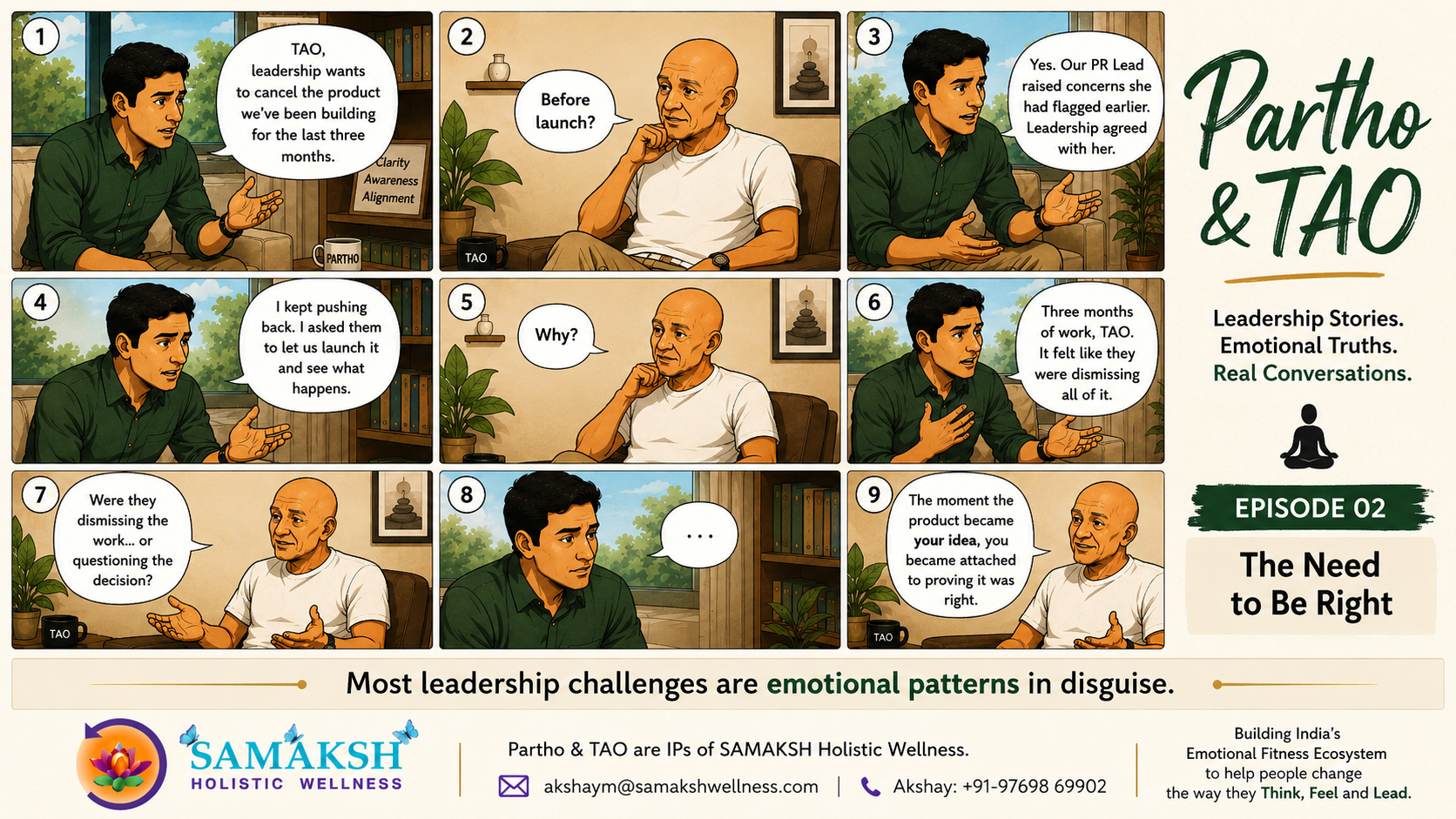
Partho & TAO: The Need to Be Right
Published On: 23 Jul 2026
Have you ever worked on an idea for months only to have someone question it just before it was about to be implemented?
It could be a product, a business proposal, a marketing campaign, a hiring decision or even a strategic recommendation that you genuinely believed was the right way forward. Naturally, after spending weeks or sometimes even months thinking about it, discussing it with your team and putting your reputation behind it, you begin to develop a sense of ownership towards it. There is absolutely nothing wrong with that. In fact, I would expect leaders to take ownership of the ideas they champion.
The challenge, however, begins when our ownership slowly transforms into attachment without us even realizing it.
Because once we become attached to an idea, questioning the idea no longer feels like a discussion around the merits of the decision. It begins to feel personal. We find ourselves explaining more, defending more and sometimes even pushing back harder, not necessarily because the idea is still the best one on the table, but because somewhere along the journey the idea has quietly become an extension of us.
This is exactly why I often say that most leadership challenges are Emotional Patterns in disguise.
What appears to be conviction may at times be our attachment to the identity we have built around that idea. What appears to be resilience may sometimes be our inability to separate ourselves from the decision we made. The discussion is no longer just about the product, the proposal or the recommendation. It slowly becomes about us proving that we were right.
The irony is that the very attachment which makes us defend the idea also makes it difficult for us to objectively evaluate it. Instead of becoming curious about the feedback we receive, we begin looking for reasons to justify our position. We stop asking, "What am I missing?" and start asking, "How do I convince them that I am right?" Without realizing it, our need to be right begins to overshadow our willingness to learn.
This doesn't mean we should stop believing in our ideas or abandon them every time someone disagrees with us. Every worthwhile idea deserves healthy debate, thoughtful discussion and sometimes even passionate disagreement. But there is a subtle difference between standing by an idea because you genuinely believe it serves the organisation, and standing by it because letting go feels like admitting that you were wrong.
Perhaps that is where the real reflection lies.
The next time you find yourself defending an idea, a proposal or a decision, don't just ask yourself whether your idea is right.
Ask yourself whether you are still discussing the idea... or protecting the identity you have attached to it.
Sometimes, that one question can change the quality of the conversation more than the strength of the argument itself.
Partho & TAO are Intellectual Properties of SAMAKSH Holistic Wellness LLP and will continue exploring business, leadership and life through the Emotional Fitness Lens.
Related post
-
Shifting Focus: From Impressing to Impactful Actions
- 28 Mar, 2024
-
Partho & TAO: The Promotion That Never Happened
- 02 Apr, 2026
