
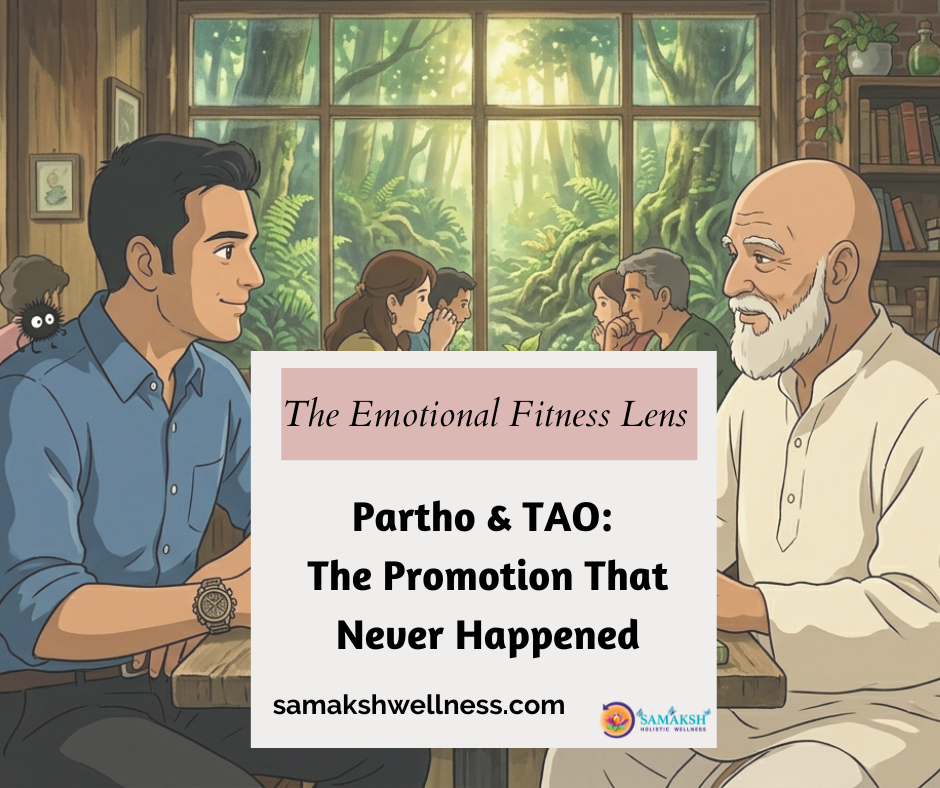
Partho & TAO: The Promotion That Never Happened
Published On: 02 Apr 2026
It was late afternoon when Partho walked into the café he often visited when he needed silence, reflection, or simply a break from the constant hum of corporate decision-making, and today he needed all three because the last twenty-four hours had left him feeling as if the ground beneath his professional identity had shifted without warning.
Partho had spent the last twelve years at SHW Technocraft, joining the company almost at its inception when the founding team was still figuring out product-market fit, when processes were fluid and titles meant less than contribution, and when everyone who stayed long enough naturally assumed they were building not just a company but also their future within it. Over the years he had risen steadily through the ranks to become Vice President – Product Design, leading teams, shaping product direction, and often being the person leadership turned to when something needed clarity or correction.
Which is why the announcement that came that morning had left him stunned.
The company had hired an external candidate as Senior Vice President of Product Management, someone no one internally had even heard of until the official communication arrived, and at the same time one of the co-founders had decided to formally assume the role of Chief Product Officer while continuing to hold her Chief Growth Officer portfolio, effectively restructuring the entire product leadership hierarchy overnight.
In one announcement — without a conversation, without context, and without even speaking to the one person who had helped build most of the product systems that now existed — Partho found out.
In the new structure he would continue as VP – Product Design, but the hierarchy was now unmistakably clear — the new SVP above him and the co-founder overseeing both of them as CPO — which meant that after twelve years of commitment, responsibility, and quiet ownership, he had suddenly moved to what felt like level three in a function he believed he had helped build.
He had read the email three times before closing his laptop.
The café door shut softly behind him as he walked in, his shoulders heavier than usual, and before he could even scan the room he heard a familiar voice from the corner table.
“You look like someone whose title stayed the same, but whose mind hasn’t.”
Partho stopped for a moment, exhaled slowly, and then walked toward the table where TAO was sitting with his usual calm expression and a cup of tea that had clearly been waiting for him longer than Partho had realized.
“You already know, don’t you?” Partho said as he dropped into the chair opposite him.
TAO smiled slightly.
“You always come here when something inside you refuses to stay quiet.”
Partho leaned back, running his hand through his hair before speaking again, the words coming out slower than usual because he was still trying to make sense of what had happened.
“Twelve years, TAO… I joined SHW when we were barely a company, when we were still experimenting with products and strategy, when everyone worked ridiculous hours because we believed we were building something meaningful, and now in one announcement they have hired someone from outside as Senior VP, made the co-founder the Chief Product Officer while she continues to be the Chief Growth Officer, and just like that I am sitting here wondering whether any of the last twelve years even mattered.”
TAO listened quietly.
Partho continued. “They didn’t even speak to me… not a conversation, not a heads-up, not even a courtesy call saying this is the direction we are thinking of taking. I woke up expecting another normal workday and ended it realizing the entire leadership structure of my function had changed and somehow I was the last person to know.”
The waiter placed his tea on the table but Partho barely noticed.
“What bothers you more,” TAO asked calmly, “the new structure or the silence before it?”
Partho didn’t answer immediately. “That they didn’t think I deserved a conversation,” he finally said.
TAO nodded slowly.
“Because when effort is not acknowledged through dialogue, the mind begins to question its own value.”
Partho leaned forward. “I am not even angry… I am confused. For years I believed I was growing with the organization, that the natural next step would eventually come, that the responsibility I was already carrying would translate into leadership recognition, and suddenly I am sitting here wondering whether I completely misunderstood my place in the company.”
TAO took a sip of his tea before speaking again. “Tell me something, Partho — when you joined the company twelve years ago, did you join because of the title you would hold twelve years later or because you believed in the work you were doing at that time?”
Partho frowned slightly. “That’s not the point.”
“It may not be the point,” TAO replied gently, “but it may be the place where your thinking has quietly shifted.”
Partho remained silent.
TAO continued. “You are experiencing what many professionals experience at some point in their career — the moment when an organizational decision collides with personal expectation — and when that happens the mind automatically interprets the event as a statement about personal worth rather than a reflection of institutional priorities.”
Partho looked at him. “So what am I supposed to do, pretend it doesn’t matter?”
TAO shook his head. “No, it matters… but what matters more is what you do with the emotion it has created.”
He paused before adding quietly. “You cannot always control the decisions an organization makes, but you always retain the ability to decide what those decisions mean for your identity.”
Partho stared at the cup in front of him, the frustration inside him slowly shifting into something more reflective. “So you’re saying I should just accept it?”
TAO smiled slightly. “I am saying you should first understand it before reacting to it.”
The café had grown quieter by now, the evening crowd not yet arriving, and for the first time since morning Partho felt the tension in his chest ease slightly.
“Maybe this moment,” TAO continued calmly, “is less about the promotion that didn’t happen and more about the question you now have to ask yourself — whether your professional identity belongs to the organization or to you.”
Partho didn’t respond immediately.
But the question had already begun to settle somewhere deeper than the disappointment he had walked in with.
The Emotional Fitness Lens
Moments like this often feel like professional setbacks, but they are usually deeper identity disruptions because when we spend years investing our effort, loyalty, and belief into an organization we unknowingly begin to merge our self-worth with our role within it, and when that role shifts unexpectedly the emotional reaction is not just about the decision but about the meaning we attach to it.
Emotional Fitness is not about suppressing that reaction — it is about developing the inner stability to respond thoughtfully rather than react impulsively.
Three Lessons in Emotional Fitness
1. Emotional Fitness
Not every organizational decision is a judgment of your capability, but the moment you internalize it as one your emotional stability becomes dependent on external validation.
2. Inner Agency
When circumstances change unexpectedly, the most powerful question is not “Why did this happen to me?” but “What do I choose to do with this moment?”
3. Mind–Body Alignment
Career uncertainty often shows up first as mental noise and physical tension, and the ability to pause, reflect, and regain clarity prevents temporary events from becoming long-term emotional stress.
Partho finished his tea slowly before looking up at TAO again. “Tell me something honestly,” he said.
“Is this the moment I should start looking for another job… or the moment I should start looking at myself differently?”
TAO smiled. “That,” he said calmly, “is the real conversation we should have next.”
Question for you
Have you ever experienced a moment in your career where an organizational decision forced you to rethink your professional identity?
(Partho and TAO shall return in the next post, as the conversation has only just begun.)
