
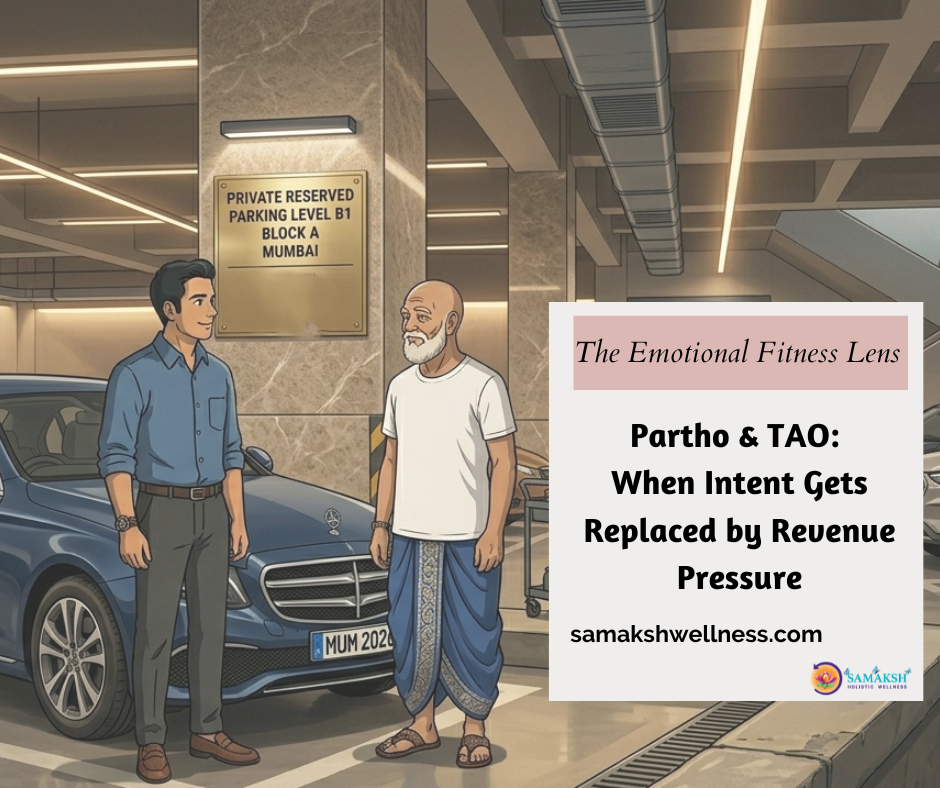
Partho & TAO: When Intent Gets Replaced by Revenue Pressure
Published On: 06 May 2026
Partho had been working as the VP – Growth & Client Impact at SHW Technocraft for the past four years, a role that placed him at the intersection of external client expectations and internal execution realities, and for a long time he had genuinely believed that this was one of the most meaningful places to operate in because he was not just driving growth conversations but also translating client intent into product direction while constantly ensuring that engineering, delivery, and marketing teams stayed aligned with what was being promised outside, even when the system itself was still evolving.
But things had started to shift slowly after SHW Technocraft was acquired by SamAyush Media Group the previous year.
On the surface, nothing changed dramatically, and the organisation still spoke the language of openness, collaboration, and people-first culture, but internally decision-making had gradually started moving toward scale, revenue, visibility, and high-impact deals, and over time the conversations that once revolved around intent, product depth, and customer value were increasingly being replaced with discussions around larger clients, awards, and quarterly growth pressure.
Partho could feel this change not in one moment, but in repeated daily patterns.
Product discussions became more siloed than collaborative, engineering teams began operating within stricter delivery boundaries rather than shared ownership, CX teams were under pressure to close escalations faster without always addressing root causes, and leadership conversations increasingly prioritised bigger deals over better outcomes, and slowly this created a constant friction inside Partho’s role because the clients he was responsible for were still expecting the same level of clarity, quality, and commitment that SHW Technocraft was once known for, even though internally the definition of priority had already started to evolve.
Over time, his clients also began noticing the gap.
Escalations increased around delayed responses, inconsistent execution quality, and misalignment between what was promised and what was actually being delivered, and while Partho kept trying to bridge these gaps by coordinating across teams, recalibrating expectations, and pushing for alignment, there was also a growing feeling that the weight of every misalignment was slowly getting transferred onto him, as if he was not just responsible for growth outcomes but also personally accountable for every breakdown across the system.
The shift became unavoidable during a leadership conversation when the CEO called him in.
“Partho, we need to start aiming for higher growth because at this stage sky is no longer the limit, we need to think beyond scale, beyond everything we have done so far, so stop getting stuck in operational friction, stop focusing on team-level complaints, push people harder, build alignment within your team, and start acting like a VP who drives growth, revenue, and profitability rather than someone who only carries client feedback back and forth between teams.”
The intent was ambition, but something in that moment broke Partho internally, not because he disagreed with growth, but because it reduced the very function he was performing — of being a bridge between systems — into something that sounded like noise instead of structure.
By the time he walked out of that meeting, the weight of everything that had been building over months suddenly felt heavier than usual.
Without speaking to anyone, he went down to the underground parking, sat inside his car without starting the engine, and stared ahead for a while as if trying to understand whether the system had changed or whether he had simply started seeing it differently.
And that is when he heard a familiar voice from the passenger seat.
“You always come here when things stop making immediate sense.”
Partho closed his eyes for a moment and let out a slow breath. “Took you long enough, TAO.”
TAO was already sitting there as if he had always been part of that silence, and after a pause he asked, “So tell me Partho… what exactly happened inside that room that brought you down here instead of going back to your desk?”
Partho leaned back.
“Nothing happened suddenly… that’s the problem,” he said. “Everything has been changing gradually, but today it became very clear that SHW is no longer operating the way it used to, and I am still trying to operate like it is, because I remember a version of this organisation that cared about intent, about building things properly, about long-term thinking, but now everything is being measured in revenue, scale, awards, and high-value clients, and somewhere in that shift I feel like I have become the person constantly stuck between client expectations and internal execution constraints without real control over either side.”
TAO listened quietly. “And that is what is exhausting you?” he asked.
Partho nodded.
“It is not breaking me,” he said, “it is exhausting me, because I am constantly translating between two worlds that are no longer aligned, clients expect outcomes that may not always be feasible within given timelines, internal teams are dealing with constraints that are not always visible externally, and leadership is pushing for growth that sits on top of all of this, and I am expected to hold it together without letting anything fall apart.”
TAO paused for a moment.
“Then maybe the real question,” he said, “is not what is breaking you… but what role you think you are actually playing inside this system.”
Partho looked at him.
TAO continued, “Because you are not just someone sitting in the middle of chaos, you are someone who has internal influence over how teams align, how priorities are shaped, and how execution moves forward, and at the same time you carry external responsibility for client expectations, outcomes, and commitments already made, which means you are not a messenger between two sides, you are operating at the intersection of two systems that rarely move in alignment.”
A pause settled in.
“And when systems don’t align,” TAO added, “people like you begin to believe they are responsible for holding everything together emotionally, instead of realising their real role is to translate misalignment into structured clarity that allows action to happen.”
Partho asked quietly, “So what am I supposed to do then?”
TAO replied, “You stop becoming the emotional buffer of the system, and you start becoming the catalyst within it, because the organisation will not suddenly become aligned just because you want it to, but you always have a choice in how you show up inside it — whether you absorb everything as pressure, or convert it into direction for yourself, your team, and your stakeholders.”
Silence followed, but this time it felt different.
Partho finally said, “So I have been trying to fix the system instead of understanding my position within it.”
TAO nodded, “And that shift is where emotional fitness actually begins.”
The Emotional Fitness Lens
In roles between clients and internal teams, the challenge is not just handling pressure from both sides, but understanding that you influence how work gets done internally while also being responsible for external outcomes, and when these two don’t align, what feels like confusion is often just the stress of dealing with misalignment without clear role boundaries.
Food for Thought
• A leader between clients and teams is not meant to fix every gap, but to make sure it doesn’t break the people doing the work.
• When things change, the real test is not just adapting quickly, but knowing what is yours to handle, what is not, and what you should not carry emotionally.
TAO’s Question
When you’re stuck between client demands and team reality, do you end up carrying all the pressure yourself… or finding a way to move things forward without it breaking you?
(Partho and TAO shall return in the next post)
Related post
-
Partho and TAO: Journey from Chaos to Clarity
- 28 Mar, 2024
